
E l e c t r i c F i e l d
Electric Field
Introduction
The concept of field theory was introduced by Michael Faraday.
He proposed that a charge produces an electric field in the space surrounding it. When another charge is brought into this field, it experiences a force due to the field.
Definition
An electric field is defined as the region around a charge where a test charge experiences an electric force.
Electric Field Intensity
Definition
An electric field is a vector field, characterized by both strength and direction at every point.
- The vector quantity representing field strength and direction is denoted by and is known as electric field intensity.
- It is the force per unit positive test charge placed at a point in the electric field.
Mathematical Form
The relationship is given as:
And force in the electric field is expressed as:
The strength and direction of the electric field can be determined by placing a unit positive test charge in the field.
Field Strength
The field strength at a point in the electric field is defined as the magnitude of the force experienced by a unit positive test charge placed at that point:
Field Direction
The direction in which the unit positive test charge moves (or tends to move) defines the direction of the electric field.
SI Unit
The SI unit of electric field intensity or field strength is:
- Newton per coulomb (), or
- Volt per meter ().
Determination of Electric Field Intensity
Consider a test charge placed in the electric field of a charge . The test charge is assumed to be small enough to not distort the original electric field of .
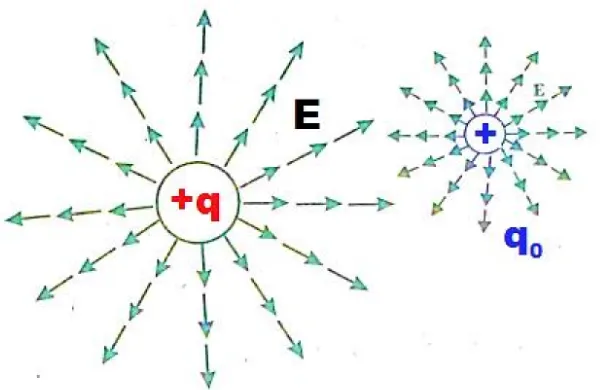
According to Coulomb’s Law, the force experienced by a unit positive test charge due to the field of point charge is:
The field intensity is given by:
Substituting the value of :
Factors Affecting Field Intensity
- Proportional to Source Charge:
The strength of the electric field is directly proportional to the magnitude of the source charge :
- Inverse Square Relationship:
The strength decreases as the distance between the source and test charge increases:
Summary
This section summarizes the key concepts related to electric fields and intensity:
Key Points:
-
Core Concept:
An electric field is the region around a charge where a test charge experiences force. Electric field intensity () quantifies this force per unit test charge. -
Important Definitions:
- Electric Field: A region of influence around a charge.
- Electric Field Intensity: A vector field that gives the force per unit test charge.
-
Key Relationships:
The electric field helps explain the behavior of charges in space and is critical in understanding electrostatic interactions.