
R e p r e s e n t a t i o n o f E l e c t r i c F i e l d L i n e s
Electric Field Lines
Definition
Electric field lines (or lines of force) are imaginary lines used to represent the electric field around a charged body. These lines depict the path a unit positive test Charge would follow when placed in the field of a source charge.
Significance
- Electric field lines help visualize the electric field.
- They act as a “map” that conveys information about the field’s strength and direction at various points.
Characteristics of Electric Field Lines
-
Direction of Field Lines:
- Radially outward for a positive charge.
- Radially inward for a negative charge.
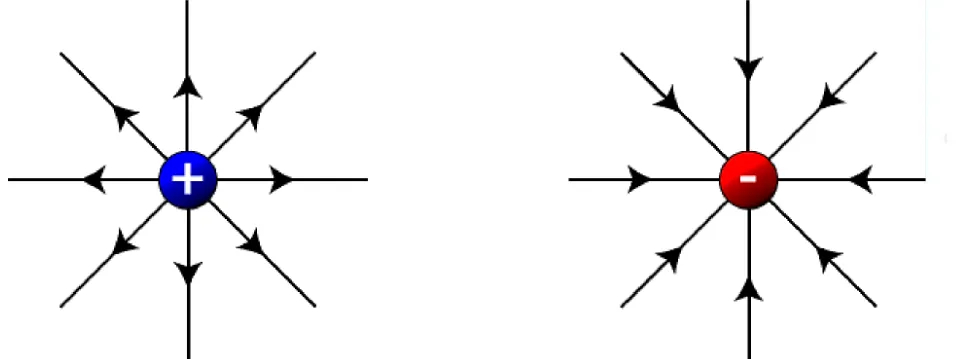
-
Origination and Termination:
- Field lines originate from a positive charge and terminate on a negative charge.
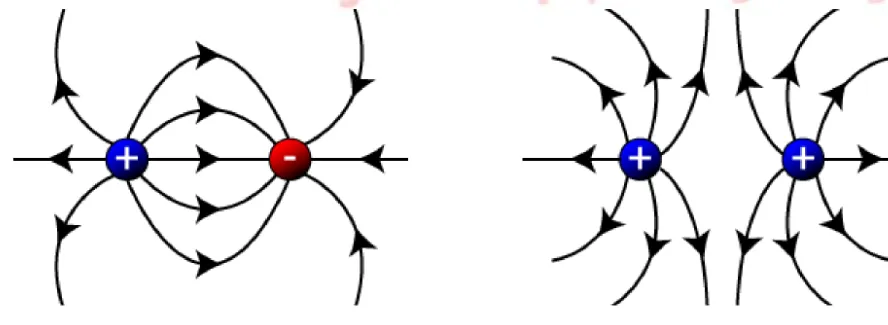
- Field lines originate from a positive charge and terminate on a negative charge.
-
Indication of Strength:
- The density of field lines indicates the field strength. It increases as we move radially inward and decreases outward.
-
No Intersecting Lines:
- Field lines never intersect because a single point cannot have two directions of the field.
-
Interaction with Conductors:
- Field lines cannot pass through a conductor, making the electric field zero inside a conductor.
-
Length and Tension:
- Field lines tend to contract in length, explaining the attraction between oppositely charged bodies.
-
Field Line Density:
- The number of field lines passing through a unit area perpendicular to the field is proportional to the magnitude of the electric field at that point.
-
Tangent to Field Lines:
- The tangent to a field line at any point gives the direction of the electric field at that point.
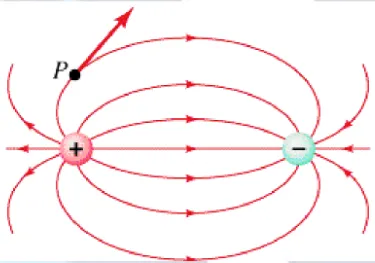
- The tangent to a field line at any point gives the direction of the electric field at that point.
-
Resultant Intensity:
- At some points, the resultant intensity is equal to the sum of intensities due to positive and negative charges. The direction aligns with the tangent to the field.
-
Neutral Points:
- Points where the resultant intensity of the electric field is zero are known as neutral points.
Uniform and Non-Uniform Electric Fields
Uniform Electric Field
A field where the strength remains the same at all points is called a uniform electric field.
- Example: The field between two infinitely large parallel charged plates.
Non-Uniform Electric Field
A field where the magnitude and direction of the electric intensity vary at different points is called a non-uniform electric field.
- Example: The field around a curved sheet of charges.
Electric Field Between Two Parallel Plates
Consider two infinitely large parallel plates separated by a small distance:
- The upper plate has a uniform positive charge distribution, and the lower plate has a uniform negative charge distribution.
- Field lines start from the positive plate and terminate at the negative plate.
- At the ends of the plates, the field lines bulge out slightly, creating a fringing field, indicating the field is non-uniform near the edges.
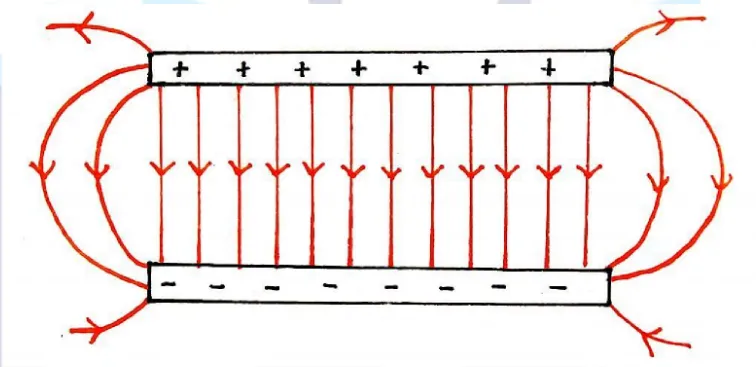
Electric Field on the Surface of a Metal Plate
If a charge is placed near a metal plate:
- The positive charge attracts the negative charges (electrons) in the metal plate.
- These charges move until some reach the surface of the plate closest to and come to rest.
- The electric field lines originating from terminate on the negative charges of the metal plate.
- These lines are always perpendicular to the surface of the metal.
Summary
Key Points
| Concept | Details |
|---|---|
| Electric Field Lines | Represent the field’s strength and direction. |
| Characteristics | Radial direction, non-intersecting, proportional to field strength. |
| Uniform Field | Field strength is constant (e.g., between parallel plates). |
| Non-Uniform Field | Field strength varies (e.g., around a curved sheet of charge). |
| Field at Metal Plate Surface | Field lines are perpendicular to the surface due to charge redistribution. |
Electric field lines provide an intuitive and visual representation of electric fields, making them essential in understanding field behavior around charges and conductors.