
A C t h r o u g h r e s i s t o r
Definition
Consider a circuit containing a Resistance connected across an alternating voltage source.
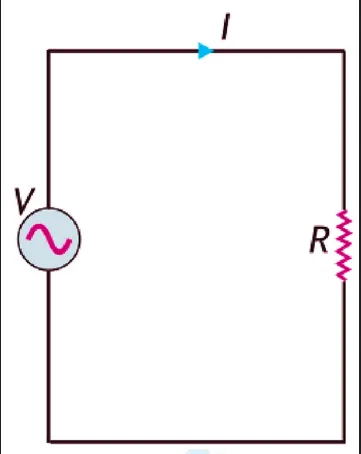
In this scenario, both the applied voltage and current pass through their zero values simultaneously and reach their positive and negative peaks at the same time. This results in the current being in phase with the applied voltage.
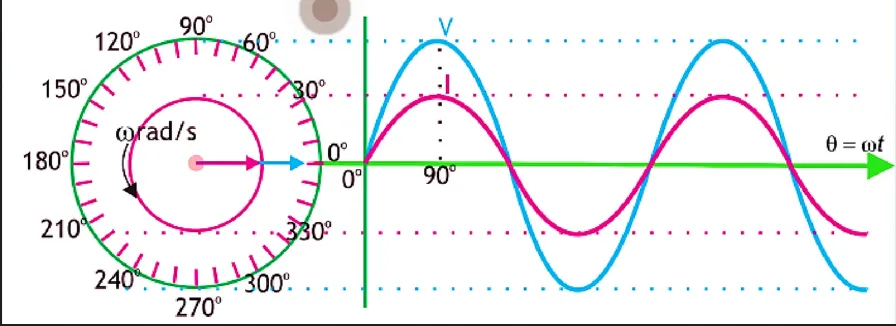
Alternating Voltage and Current
The alternating voltage is given by:
Similarly, the AC is given by:
Equations (1) and (2) show that the alternating voltage and current are in Phase of AC.
From Ohm’s Law:
Here, and represent the root mean square (R.M.S value of Sinusoidal Current) values of alternating voltage and current, respectively. Therefore:
This simplifies to:
Power Loss in a Resistor
The power curve for a pure resistive circuit is derived from the product of the instantaneous values of voltage and current.
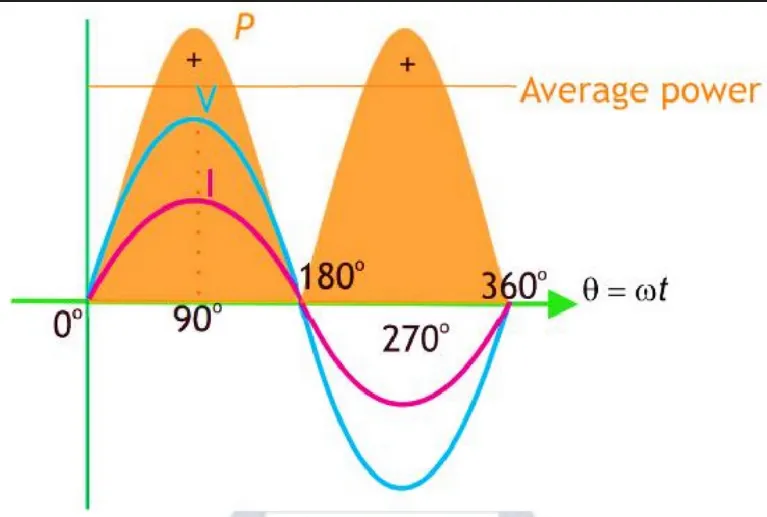
The Electric Power is always positive except at the points , , and , where it briefly drops to zero. This means the voltage source continuously delivers power to the circuit, which is consumed by the resistor.
The average power dissipated in resistor over one complete cycle of the applied voltage is:
Substituting the expressions for and :
This simplifies to:
Since:
We get:
Thus, we can rewrite this as:
We can express as , so:
Summary
In an AC circuit with a resistor, the voltage and current are in phase with each other. The power dissipated by the resistor is calculated using the RMS values of voltage and current. The power is positive throughout the cycle except at specific points, and the average power dissipation is given by the product of the RMS values of voltage and current.