
E l e c t r i c P o t e n t i a l D i f f e r e n c e
Definition
The electric potential difference between two points is the work done to move a unit positive charge from one point to another while keeping the charge in electrostatic equilibrium.
Explanation
Consider two oppositely charged parallel plates with a unit positive Charge placed between them.
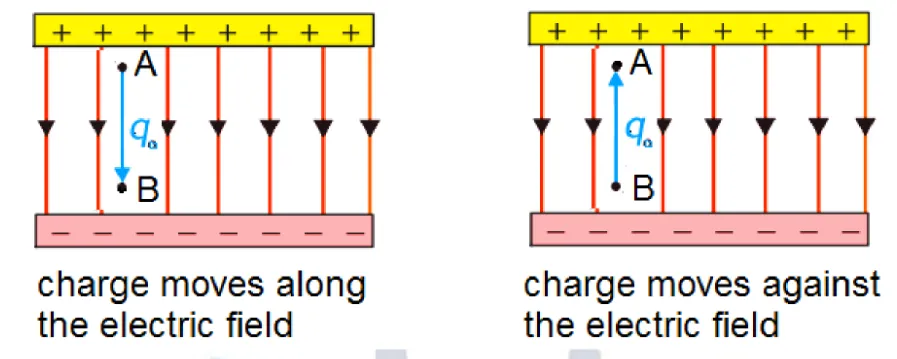
a) Movement from Positive Plate to Negative Plate
- The charge moves freely along the electric field lines toward the negative plate, driven by electric force.
- During this movement, the charge gains an equivalent amount of kinetic energy.
b) Movement from Negative Plate to Positive Plate
- To move against the direction of the Electric Field, an external force equal and opposite to must be applied.
- This keeps the charge in electrostatic equilibrium, enabling it to move at a uniform velocity without acceleration.
c) Work Done on the Charge
If:
- Potential energy at point
- Potential energy at point
- Work done to move the charge from to
Then:
Dividing both sides by :
The electric potential difference is defined as the work done per unit charge:
Physical Significance
- Determines the direction of flow for positive charges.
- Positive charges always move from higher potential to lower potential.
Nature and Units
- Electric potential difference is a scalar quantity.
- SI unit: volt (V), where:
- Multiples and submultiples of volt include:
Electric Potential
a) Definition
Electric potential at a point is the work done in bringing a unit positive charge from infinity to that point without any acceleration.
b) Explanation
From the potential difference formula:
If point is at infinity:
Then:
Thus, the absolute electric potential at a point is:
Where is the electric potential, and is the work done.
Summary
| Concept | Definition | Key Formula |
|---|---|---|
| Electric Potential Difference | Work done to move a unit positive charge between two points in electrostatic equilibrium. | |
| Electric Potential | Work done to bring a unit positive charge from infinity to a specific point without acceleration. | |
| Units | SI unit is volt (V). Other units include millivolts, kilovolts, etc. |
Significance
Understanding electric potential and potential difference is essential in analyzing electric circuits, fields, and energy transformations, enabling practical applications like batteries, capacitors, and electric power systems.