
E l e c t r i c P o t e n t i a l E n e r g y d u e t o a P o i n t c h a r g e
Electric Potential Energy
Definition
Electric potential energy at a point is the work done against the electric field when a unit positive Charge is brought from infinity to that point. The unit charge is moved without accelerating.
Explanation
Consider an isolated charge fixed in space. A test charge is initially at infinity and is moved towards the charge . Due to the repulsive force between the two charges, external work must be done to move the test charge from infinity to a point near the charge .
- External work is required to bring the charge from infinity to point B due to the repulsion between the charges. This results in a negative work value.
- Let the test charge be at a large distance from charge . The distance between and is divided into infinitesimally small displacements , ensuring that the field intensity remains constant over each displacement.
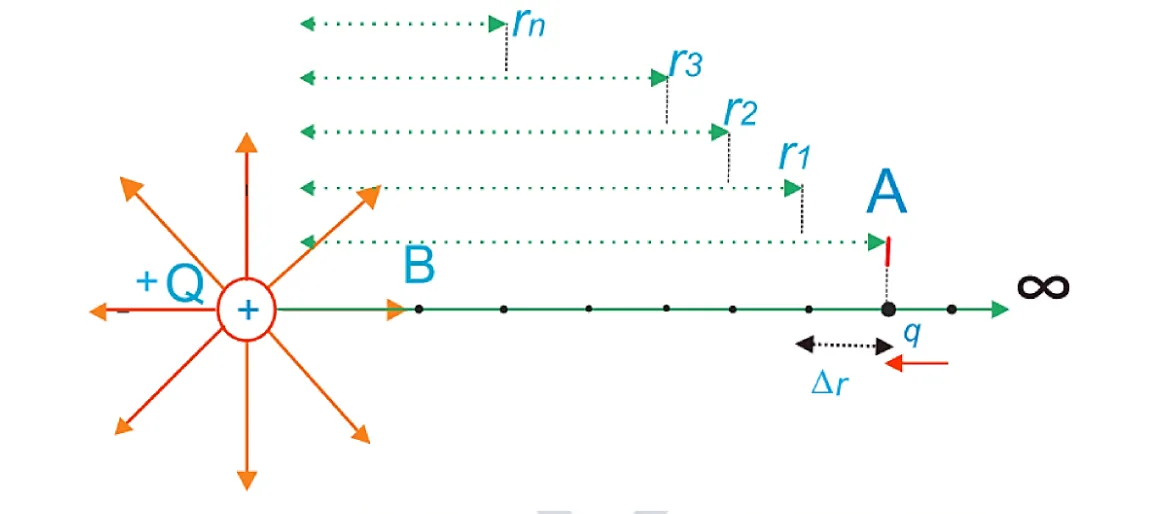
Work from to
The test charge is moved from to with a small displacement . Since external work is done to move the charge against the electric field, we include a negative sign in the equation.
Substitute the expression for force :
Since (because the test charge is moved against the electric field), we have:
Rewriting in terms of and :
Work from to
Similarly, the work done in moving the test charge from to is given by:
Work from to
For the final displacement, the work done to move the charge from to is:
Total Work from to
The total work done from to can be written as the sum of all the infinitesimal works:
Simplifying the series, we get:
The work done to move a test charge from infinity to a distance from is:
Thus, the work done is given by:
Therefore, the electric potential energy is:
Electric Potential
The electric potential at a distance from is defined as:
Substituting :
Simplifying:
Thus, the electric potential is:
Summary
-
Electric Potential Energy: The work done to move a test Charge from infinity to a point near a charge in an Electric Field.
-
Electric Potential: The potential energy per unit charge at a point in the field.
Important Relationships:
- Work Done:
- Electric Potential:
| Concept | Formula | Description |
|---|---|---|
| Electric Potential Energy | Work done to move a test charge in an electric field. | |
| Electric Potential | The potential energy per unit charge at a point in the field. |
Electric potential energy and potential are crucial concepts in understanding how charges interact within electric fields. These principles have broad applications in areas such as electrostatics, capacitors, and more.
References
OR