
P o t e n t i a l G r a d i e n t
Definition
The potential gradient represents the rate of change of Electric Potential Difference () with respect to displacement (). It indicates how the potential varies in space. Mathematically, it is given by:
Relation Between Electric Field & Potential Gradient
The relationship between the Electric Field and potential gradient can be understood by analyzing a uniform electric field, where the lines of force are parallel and equally spaced.
Explanation
-
Setup:
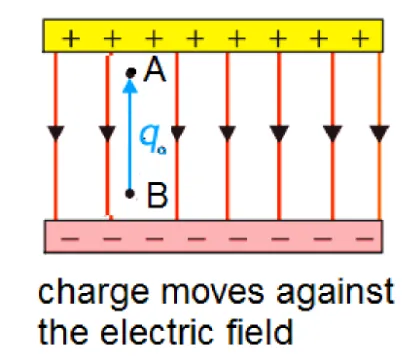
- A uniform electric field is considered, with lines of force parallel and equidistant.
- Points A and B are two very close points such that the electric field intensity remains constant over this small distance.
-
Work Done:
When a test Charge is moved a small distance from point B to point A:
Substituting the force :
- Considering Directions:
Since the charge moves against the electric field, the angle between and is . Therefore:
Simplifying using :
- Electric Potential Difference:
Dividing by the test charge :
Since , we can write:
- Electric Field Relation:
Rearranging the equation to express the electric field in terms of potential gradient:
Conclusion
- Field Strength and Gradient: The magnitude of the electric field is proportional to the rate of change of potential (potential gradient).
- Direction: The negative sign shows that the electric field points in the direction of decreasing potential.
This is analogous to how gravitational fields behave, where objects move from high to low potential energy.
Summary
| Concept | Description |
|---|---|
| Potential Gradient | Rate of change of Electric Potential Difference with displacement, . |
| Electric Field (E) | Strength of the Electric Field is proportional to the potential gradient, . |
| Direction | Electric field points in the direction of decreasing potential, opposite to the gradient. |
Core Relationship:
The electric field is derived from the spatial rate of change of potential. This helps us calculate field strength in practical scenarios like capacitors or charged plates.
Significance:
Understanding the connection between potential gradient and electric fields allows us to predict how charges behave in different configurations, critical for designing electrical systems.