
D r i f t V e l o c i t y I n C o n d u c t o r
1) Definition
Drift velocity () refers to the net velocity with which free electrons move through a conductor under the influence of an external electric Field.
2) Explanation
Without External Voltage
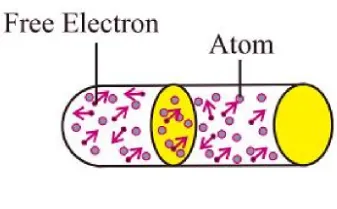
In a conductor, the atoms form a lattice structure, and free electrons move randomly within this lattice. Due to their random motion, the average velocity of these electrons in the absence of an external force (such as an electric field) is zero.
The electrons are constantly colliding with the atoms of the conductor, but because their motion is random, there is no overall movement in any specific direction.
With External Voltage
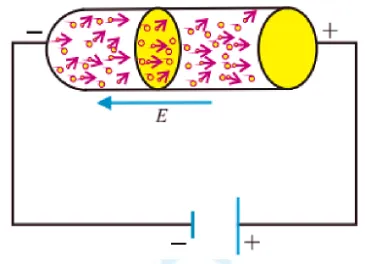
When a Electric Potential Difference (or voltage) is applied across the conductor, an Electric Field () is established within the wire.
The presence of this electric field exerts a force on the free electrons, causing them to accelerate in the direction opposite to the electric field (since electrons are negatively charged). However, as they continue to move, they experience collisions with the atoms in the conductor, which impedes their motion and causes them to lose some of their velocity.
Despite these collisions, the electrons continue to move with a net drift in one direction, resulting in a steady drift velocity. This drift velocity is much smaller compared to the random thermal velocities of the electrons, but it is the key factor responsible for the flow of current through the conductor.
Summary
Key Points:
- Core Concept: Drift velocity is the net velocity of electrons in a conductor when subjected to an external electric field, causing them to move in a specific direction.
- Important Definitions:
- Drift Velocity (): The average velocity of free electrons due to the influence of an electric field.
- Electric Field (): A force field that drives the movement of charged particles.
- Key Relationships/Processes:
- Without External Voltage: Electrons move randomly with no net velocity.
- With External Voltage: The electric field causes electrons to acquire drift velocity, resulting in a net flow of current.
| Concept | Description |
|---|---|
| Drift Velocity () | The velocity of free electrons in the direction of the applied electric field. |
| Electric Field () | A force field that drives the movement of charged particles. |
Real-World Application
Drift velocity is a fundamental concept in understanding Electric Current and its flow in conductors. It is essential for explaining how electric circuits work, as the movement of electrons due to drift velocity leads to the observable flow of current.