
E q u i p o t e n t i a l S u r f a c e s
1) Definition
An equipotential surface is a surface where the electrostatic potential is the same at every point on it. These surfaces are imaginary and surround a Charge distribution, representing regions of equal Electric Potential Difference.
2) Explanation
An equipotential surface can be either the surface of a body or a surface in space. By connecting points that have the same potential, we can draw an equipotential surface in a region where an Electric Field exists. In simple terms, an equipotential line connects points where the potential in an electric field is identical.
a) Importance of Equipotential Surfaces
Equipotential surfaces visually represent electric potential. They help to understand the relationship between electric fields and potentials by showing where potential is the same across different locations.
b) Diagram
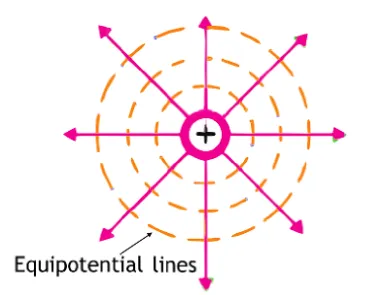
- The arrow lines in the diagram represent electric field lines.
- The dashed lines represent equipotential surfaces or equipotential lines
Learn more about electric field lines at Representation of Electric Field Lines
c) Characteristics of Equipotential Surfaces
i) Work Done
- The work done to move a charge from one point to another along an equipotential surface is zero.
- This is because all points on an equipotential surface have the same potential, meaning there is no potential difference, and no work is required to move the charge.
ii) Electric Field & Equipotential Surfaces
- The electric field is always normal (perpendicular) to the equipotential surface at every point. This is because no work is done in moving a charge along an equipotential surface, which means the field cannot have a component along the surface.
iii) Field Strength & Equipotential Surfaces
- Equipotential surfaces are closer together in regions where the electric field is strong and farther apart in regions of weak electric field strength. This is because the electric field strength is proportional to the rate of change of potential, so a stronger field results in a smaller distance between surfaces.
iv) Intersection of Equipotential Surfaces
- Equipotential surfaces can never intersect each other. If two surfaces intersected, it would imply that there are two different potentials at the same point, which is impossible.
3) Equipotential Surfaces of a Positive Point Charge
- The equipotential surfaces surrounding a single positive point charge are concentric spherical shells, with the center of the spheres at the point charge.
- The electric field lines are perpendicular (normal) to the equipotential surfaces at every point on the surface.
4) Equipotential Surfaces of Two Opposite Charges
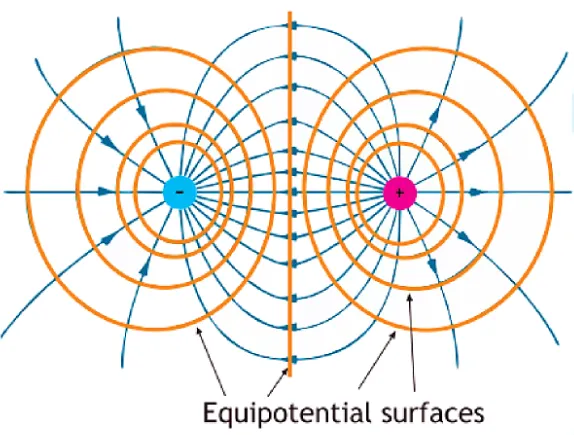
- The potential at any point between two opposite Charges is the sum of the potentials due to each individual charge.
- Equipotential surfaces are closer together in the region between the two opposite charges, indicating a stronger electric field in that region.
5) Example of Equipotential Surface
A practical example of an equipotential surface is the surface of a charged conductor. The surface of a conductor in electrostatic equilibrium is an equipotential surface because the electric potential is the same at every point on the surface.
Summary
- Core Concept: Equipotential surfaces represent regions of equal electrostatic potential in an Electric Field, and the electric field is always normal to these surfaces.
- Important Definitions:
- Equipotential Surface: A surface where the electrostatic potential is constant at every point.
- Electric Field: The field that exerts force on Charges, always perpendicular to the equipotential surface.
- Key Relationships/Processes:
- Work done in moving a charge along an equipotential surface is zero.
- Equipotential surfaces are closer in strong fields and farther apart in weak fields.
| Concept | Explanation |
|---|---|
| Equipotential Surface | A surface with constant electrostatic potential. |
| Electric Field & Equipotential Surface | Electric field lines are normal to equipotential surfaces. |
| Work Done on Equipotential Surface | No work is done when moving along an equipotential surface. |
| Field Strength | Closer equipotential surfaces indicate stronger fields. |
In conclusion, understanding equipotential surfaces is essential in analyzing electric fields and potentials, especially in electrostatics. These concepts have applications in the design of electrical equipment, where controlling and understanding electric fields and potentials is crucial.